




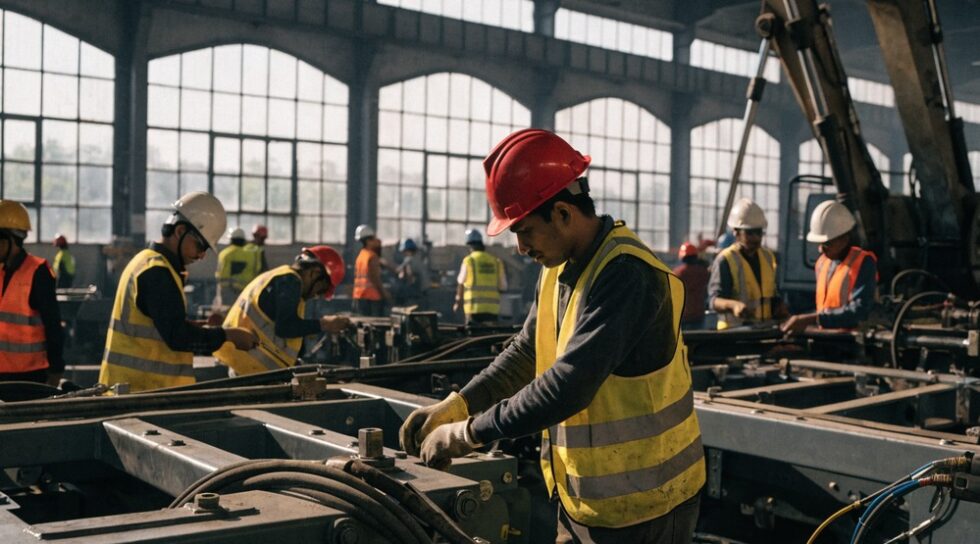
India’s government is preparing to sign off on a $1.2 billion incentive package intended to grow domestic manufacturing of advanced construction and infrastructure machinery. Officials expect the plan to be finalized in the near term. Under its terms, manufacturers who set up or expand production within the country over a seven year window would receive financial incentives, with the overall program projected to pull in roughly $1.8 billion in new private investment. The categories targeted include large boring machines used for tunneling, systems built for fire suppression, and lift equipment installed in tall buildings.
The push comes after several years of strained supply from China, India’s traditional source for much of this machinery. Tensions between the two countries date back to a deadly military clash along their shared border in 2020, after which India tightened rules around Chinese investment and blocked Chinese firms from bidding on many public contracts. China, in turn, began slowing down customs approvals for tunnel boring equipment bound for India starting in 2024. The impact showed up clearly in trade figures, with the value of tunneling machinery imported from China shrinking to a tiny portion of what it had been just a couple of years earlier. Officials from both nations have since discussed the matter directly. This year, India loosened some of its earlier curbs, permitting Chinese companies to invest under certain conditions and to bid for a limited set of government projects, while simultaneously trying to grow its own manufacturing base so it depends less on outside suppliers going forward.
Those familiar with the plan’s development say its underlying goal is straightforward: close the gap between what India currently builds domestically and what it still has to import because local factories can’t yet produce it. Backers of the scheme also connect it to India’s larger infrastructure agenda, pointing to ongoing work on highways, metro rail, and airport expansion as reasons the timing makes sense. The domestic market for this kind of machinery is currently estimated at around $10.5 billion and is expected to grow alongside that construction activity. Advocates say boosting local production could ease import dependence for these projects and generate manufacturing jobs, although the government has not released specific projections for how many positions the scheme might create.
How well the plan performs will likely come down to details that haven’t been settled yet, such as how the incentive payments will actually be structured and how fast manufacturers can ramp up. Looking at similar efforts elsewhere in India’s industrial policy is instructive. Its electronics component initiative, for example, has greenlit projects worth several billion dollars and anticipates tens of thousands of new jobs, but those results are expected to materialize gradually rather than right after approval. India’s wider production linked incentive program, running since 2020 across more than a dozen sectors, has so far disbursed only a portion of its total budget relative to the private capital it has attracted, showing that a scheme’s headline number and its actual delivered impact can differ substantially.
Based on that track record, the deciding factor for this scheme may be less about how much money is allocated and more about how efficiently it reaches manufacturers, whether domestic firms can source the technical know how required, and whether supporting infrastructure and rules keep up with the policy’s aims. The scheme itself still awaits formal government approval, and its final shape could shift before then.