




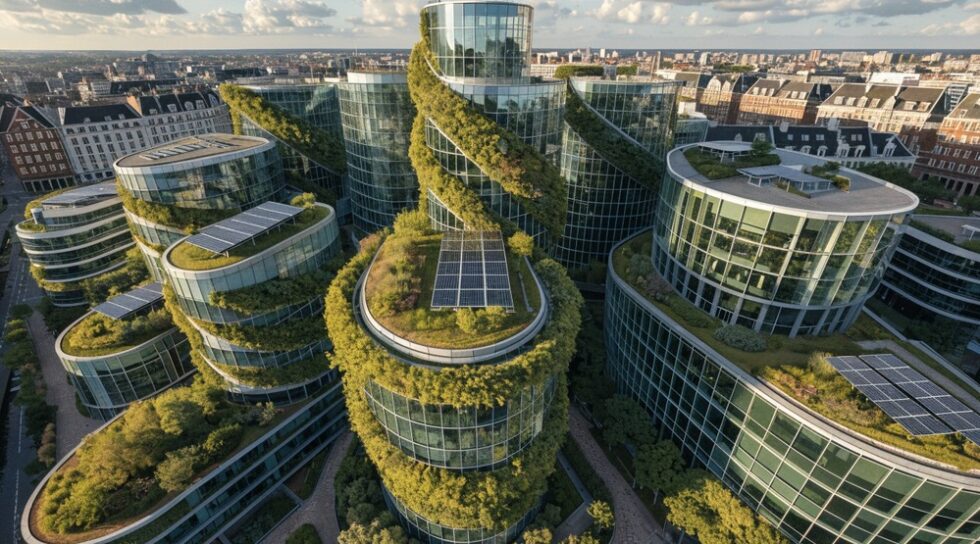
The construction sector accounts for roughly a third of global carbon emissions, a figure that has kept the industry under sustained pressure from regulators, insurers, and buyers alike. What’s changed by 2026 isn’t the pressure itself, but how the industry is responding to it: more precise carbon accounting, new materials entering mainstream use, and a growing recognition that the greenest building is sometimes the one that already exists.
Counting carbon differently
For years, sustainability efforts centered almost entirely on operational energy, how much power a building consumes once occupied. That focus is shifting. Industry practice in 2026 increasingly accounts for embodied carbon: the emissions generated in manufacturing, transporting, and installing materials before a building is ever used. Depending on the project, embodied carbon can represent anywhere from a fifth to half of a high-performance building’s total emissions footprint, making it too large a share to ignore.
This shift has made Environmental Product Declarations, standardized documents detailing a material’s environmental impact, a routine part of specification on larger commercial projects rather than a niche request. The latest LEED certification update, released this year, reflects the same trend, placing more weight on whole-life carbon performance rather than energy use alone.
Materials doing double duty
Material innovation has moved beyond simple substitution. Recycled steel remains the most reused material in construction by volume, but newer entrants are changing what “sustainable” means on a job site. Low-carbon concrete formulations can cut emissions by roughly a third to nearly half compared with conventional mixes, and more advanced versions push that reduction close to three-quarters. Bio-based options such as cross-laminated timber and hempcrete are being specified for their insulating properties as much as their lower manufacturing footprint.
Some more experimental materials hint at where the sector may be headed next: algae-based panels that generate energy while filtering air, and 3D-printed components built from recycled plastics or low-carbon cement blends. These remain early-stage rather than mainstream, but they point toward materials built to serve more than one function at once.
Retrofitting over rebuilding
One of the more understated trends this year is a growing preference for adapting existing buildings rather than demolishing and starting over. Reuse avoids the embodied carbon cost of extracting, manufacturing, and transporting entirely new materials, and retrofitted buildings that preserve their original structure typically take less time and money to complete than new builds. With global building stock projected to roughly double by mid-century, extending the life of what’s already standing is becoming as relevant as how the industry designs what comes next.
Policy and electrification
Regulatory tightening continues to shape material and design choices. Energy codes are becoming stricter in most major markets, and incentive programs are accelerating a shift toward electrified building systems, with heat pump adoption picking up noticeably in both new construction and retrofits.
Where this leaves builders
Demand for green building materials is projected to keep growing at a double-digit annual pace through the end of the decade, led by commercial and industrial projects. For contractors and developers, that means sourcing decisions now carry documentation requirements that didn’t exist a few years ago, retrofit work is increasingly worth weighing against new-build alternatives, and material choices are being judged on lifecycle impact rather than upfront price alone.
None of this suggests the industry has solved its emissions problem. It suggests the tools for addressing it have moved from pilot projects into standard practice.